How to Build Predictable Workflows
- Mar 18
- 3 min read
In many organizations, work feels unpredictable.
Projects move forward quickly for a while, then suddenly stall. Tasks get completed in different ways depending on who is involved. Teams constantly need meetings just to figure out what should happen next.
This unpredictability is rarely caused by a lack of effort.
More often, it happens because workflows have never been intentionally designed.
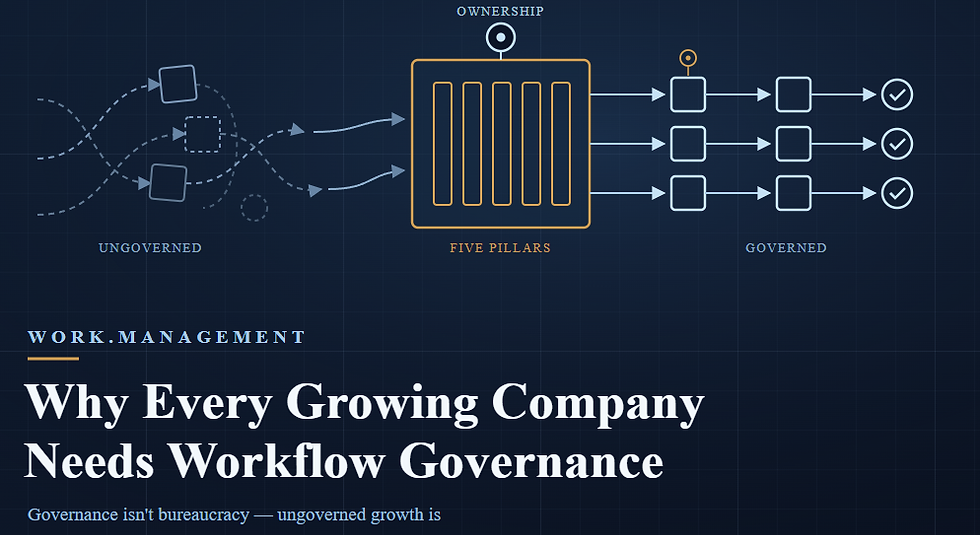
Predictable workflows do not happen by accident. They are built through clear structure and coordination.
What Makes a Workflow Predictable
A predictable workflow allows work to move forward without constant clarification.
People know:
What the next step is
Who is responsible for each stage
Where the work currently stands
What needs to happen before work can move forward
When these elements are clear, work flows naturally.
When they are unclear, teams rely on messages, meetings, and manual follow-ups to keep work moving.
Step 1: Define the Stages of the Workflow
Every workflow moves through a series of stages.
For example, a marketing campaign workflow might include:
Idea
Planning
Content creation
Review
Launch
The goal is to clearly define how work progresses from start to finish.
Without defined stages, work tends to jump around randomly, making it difficult to track progress or identify bottlenecks.
Step 2: Assign Ownership at Each Stage
A predictable workflow requires clear ownership.
Each stage of the workflow should have a defined owner responsible for moving the work forward.
Ownership does not mean doing all the work.
It means being accountable for ensuring the work progresses through that stage.
Without ownership, work often stalls while everyone assumes someone else is responsible.
Step 3: Make Work Visible
Predictable workflows require visibility.
Teams should be able to quickly see:
What work is currently in progress
What stage the work is in
What work is waiting or blocked
Visibility reduces the need for status meetings and constant updates.
When work is visible, coordination becomes much easier.
Step 4: Define What Moves Work Forward
A common cause of stalled work is unclear handoffs.
Teams may complete their part but not know when or how to pass the work to the next stage.
Each stage should clearly define:
What needs to be completed
What signals the work is ready to move forward
Who receives the work next
These rules create smoother transitions between stages.
Step 5: Reduce Coordination Friction
Even well-designed workflows can become unpredictable if coordination is difficult.
Organizations should look for ways to reduce friction by:
Limiting unnecessary meetings
Clarifying communication channels
Standardizing how work requests are made
Avoiding constant priority changes
The smoother the coordination, the more predictable the workflow becomes.
Predictability Improves Speed
Some organizations resist structured workflows because they believe structure slows things down.
In reality, the opposite is true.
When workflows are predictable:
Teams spend less time figuring out what to do
Work moves forward with fewer interruptions
Bottlenecks become easier to identify and fix
Predictability creates momentum.

Final Thought
Unpredictable work environments are rarely chaotic because people are unmotivated.
They are chaotic because workflows are unclear.
Predictable workflows emerge when organizations define stages, clarify ownership, make work visible, and reduce coordination friction.
When these elements are in place, work stops feeling chaotic — and starts moving forward consistently.