The Hidden Work Management Problem Behind AI Adoption
Artificial intelligence has rapidly become part of everyday work. Organizations are investing heavily in AI tools, employees are experimenting with new ways of working, and vendors continue to promise significant productivity gains.
In many ways, those promises are proving true.
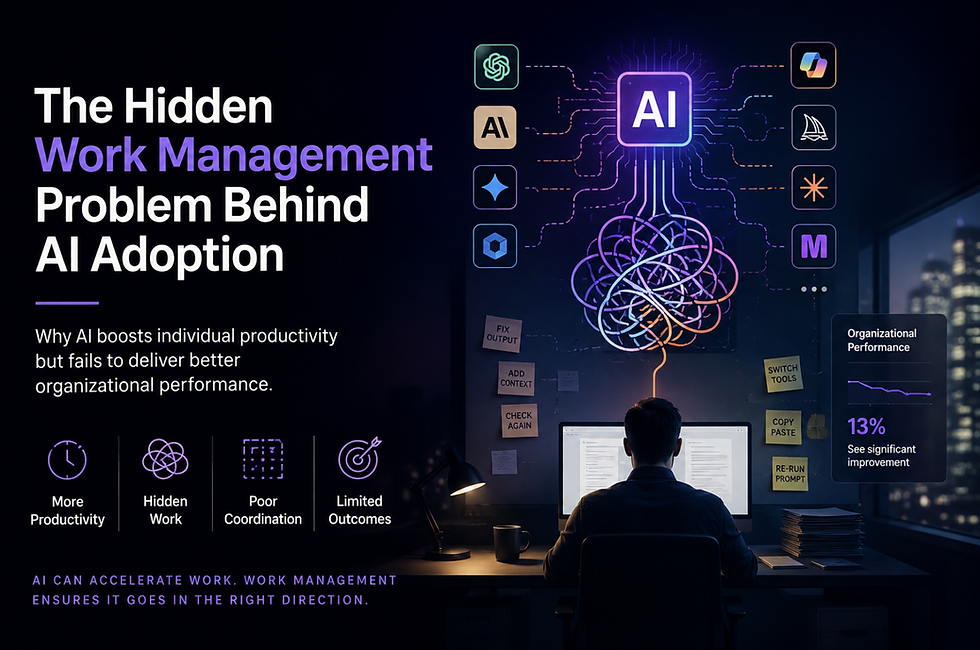
According to the latest Work AI Index, 87% of digital workers now use AI at work, and 75% report that AI makes them more productive. Yet only 13% believe their organization is performing significantly better because of AI.
This raises an important question:
If AI is making individuals more productive, why aren't organizations seeing proportional improvements in performance?
The answer may have less to do with AI itself and more to do with how work is managed.
The Productivity Paradox of AI
Most AI conversations focus on what the technology can do:
Generate content
Analyze information
Automate tasks
Build workflows
Assist decision-making
These capabilities are impressive, and many workers are finding real value in them.
However, organizational performance is not simply the sum of individual tasks completed faster.
Organizations succeed when work is:
Clarified
Coordinated
Completed
When any of these elements break down, productivity gains at the individual level often fail to translate into meaningful organizational outcomes.
This is what the Work AI Index highlights. Workers report saving significant time through AI, yet organizations struggle to realize corresponding improvements in execution, alignment, and results.
What Is Botsitting?
One of the report's most interesting concepts is a term called botsitting.
Botsitting refers to the hidden work employees perform to make AI useful, including:
Feeding AI additional context
Verifying outputs
Correcting mistakes
Re-running prompts
Cleaning up AI-generated work
The report found that workers spend an average of 6.4 hours per week on these activities.
In other words, much of the time saved through AI is being reinvested into managing AI itself.
From a work management perspective, botsitting is often a symptom of a deeper issue.
When work lacks clarity, people must continuously provide context, explain requirements, and validate results. AI simply makes these weaknesses more visible.
The problem is not necessarily the AI.
The problem is that the work was never sufficiently clarified in the first place.
The AI Toggle Tax Is Really a Coordination Tax
The report also introduces the concept of the AI Toggle Tax.
Many workers now move between multiple AI tools, repeatedly transferring information, re-entering context, and comparing outputs.
The result is increased cognitive effort and coordination overhead.
This is often treated as a technology problem.
However, from a work management perspective, it is fundamentally a coordination problem.
Organizations frequently implement multiple systems, tools, and platforms without fully designing how work should flow between them.
As a result, employees become the integration layer.
They manually move:
Information
Context
Decisions
Requests
Approvals
between disconnected systems.
When workers spend more time coordinating tools than advancing work, the issue is not AI adoption.
The issue is coordination maturity.
Why Productivity Gains Don't Automatically Create Better Outcomes
One of the most common mistakes organizations make is confusing activity with outcomes.
AI can help teams:
Write faster
Analyze faster
Respond faster
Produce more output
But producing more output does not automatically create better results.
This is where many organizations encounter what could be called the AI Productivity Paradox.
Individual productivity increases.
Organizational performance remains relatively unchanged.
Why?
Because outcomes depend on more than execution speed.
They depend on:
Alignment
Accountability
Decision-making
Prioritization
Collaboration
Coordination
If these capabilities remain weak, faster task execution simply allows organizations to move inefficiently at a higher speed.
AI Is Exposing Workflow Architecture Problems
The report repeatedly describes workers acting as the bridge between disconnected tools and systems.
This is an important observation.
When humans become responsible for manually transferring context between systems, workflow architecture is often the underlying challenge.
Strong workflow architecture helps ensure that:
Information flows predictably
Ownership is visible
Decisions are documented
Context travels with the work
Dependencies are understood
Weak workflow architecture creates friction.
Employees compensate by creating workarounds, duplicating effort, and manually connecting systems that were never designed to work together.
AI may accelerate certain activities, but it cannot eliminate architectural weaknesses in how work moves through an organization.
In many cases, it simply exposes them faster.
The Rise of Human-Agent Teams
As AI becomes embedded in everyday work, organizations are beginning to move beyond simple tool usage.
Increasingly, work is performed through collaboration between humans and AI systems.
This creates a new challenge.
Organizations must learn how to manage work across both human and digital contributors.
Success is no longer about managing only people or only technology.
It is about managing collaboration between both.
Human-agent teams require systems that help participants:
Clarify work
Coordinate work
Complete work
Without these foundations, organizations risk creating faster workflows that generate more confusion, more rework, and more hidden labor.
AI Doesn't Replace Work Management
The Work AI Index highlights an important reality that many organizations are beginning to discover.
AI can accelerate work.
It can automate tasks.
It can improve individual productivity.
But it cannot replace the systems required to manage work effectively.
Organizations that realize the greatest value from AI will not necessarily be those with the most advanced models, the most agents, or the largest AI budgets.
They will be the organizations that build the capabilities required to clarify, coordinate, and complete work consistently.
As AI becomes more powerful, work management becomes more important—not less.
The future of work will not be defined solely by artificial intelligence.
It will be defined by how effectively organizations manage the collaboration between people, processes, workflows, and intelligent systems.
Because AI may accelerate work, but only work management can ensure that work moves in the right direction.


