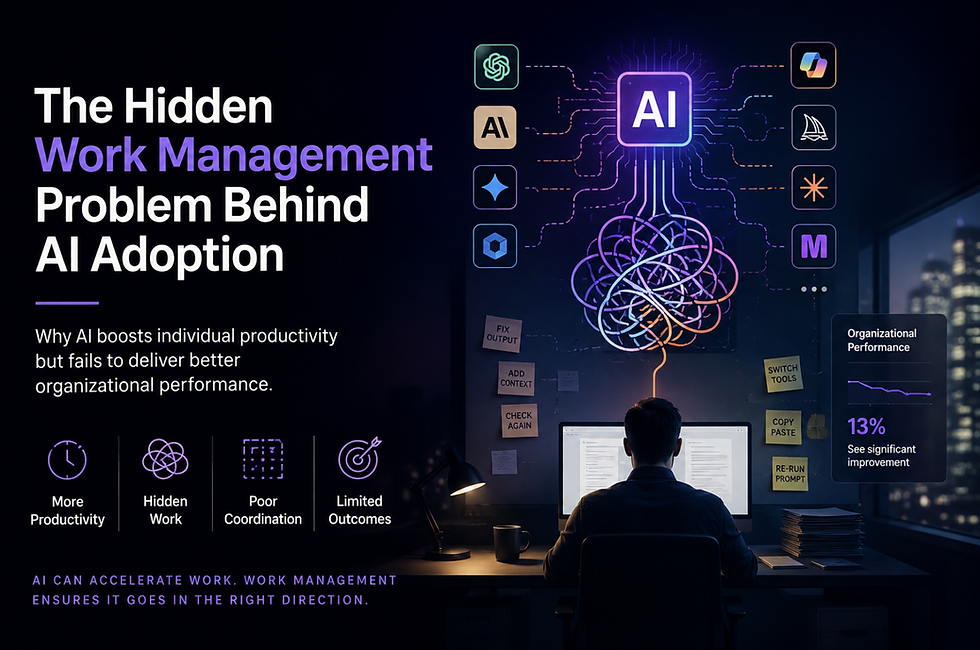
Your AI Isn't Failing. Your Workflow Architecture Is.
- 9 hours ago
- 4 min read
Artificial intelligence is everywhere.
Organizations are deploying AI copilots, building autonomous agents, experimenting with automation, and investing billions of dollars in technologies that promise to transform the way work gets done.
Yet despite the excitement, many leaders are asking the same question:
Why aren't we seeing the results we expected?
The common assumption is that the AI isn't capable enough, the model isn't accurate enough, or employees simply aren't embracing the technology.
But in many cases, the real problem isn't the AI.
It's the workflow architecture the AI is operating within.

AI Is Only as Effective as the Workflows That Support It
AI doesn't work in isolation.
Whether you're using a chatbot, an AI agent, or an automated workflow, every AI system depends on an underlying system of work. It relies on clear processes, reliable information, defined responsibilities, and predictable decision-making.
When those foundations are weak, AI inherits the same problems that humans have been struggling with for years.
If work is already difficult to coordinate, AI won't magically solve it.
Instead, it often exposes the weaknesses that were already there.
Automation Doesn't Fix Chaos—It Accelerates It
Imagine asking an AI agent to process customer refund requests.
On paper, it sounds straightforward.
But behind the scenes:
Customer information exists across multiple systems.
Refund policies vary by location.
Approval rules aren't documented.
Employees handle exceptions differently.
Requests arrive through email, chat, phone calls, and support tickets.
No one actually owns the end-to-end workflow.
Now ask an AI agent to operate inside that environment.
Should it approve the refund?
Escalate it?
Request additional information?
Follow one employee's process or another's?
The AI isn't confused because it's unintelligent.
It's confused because the workflow lacks clarity.
This is one of the biggest misconceptions surrounding AI adoption. Organizations often expect AI to organize work that has never been intentionally organized in the first place.
Technology can execute a process, but it cannot define one.
The Symptoms Often Blamed on AI
When AI initiatives struggle, organizations frequently point to the technology itself.
They report issues like:
Inconsistent outputs
Hallucinations or inaccurate recommendations
AI agents getting stuck during execution
Automations requiring constant human intervention
Employees ignoring AI-generated suggestions
Duplicate work between people and AI
Low adoption across teams
While these problems can sometimes stem from limitations in the technology, they are often symptoms of something much deeper.
They point to unclear workflows, inconsistent processes, fragmented information, and undefined ownership.
In other words, they reveal problems with workflow architecture.
Workflow Architecture Is the Missing Foundation
Workflow architecture is the intentional design of how work moves through an organization.
It defines:
How work begins
Who owns each stage
What information is required
Where decisions are made
How work transitions between people, teams, and systems
Where automation and AI should be introduced
How success is measured and continuously improved
Without this foundation, organizations often automate isolated tasks instead of improving the overall flow of work.
The result is faster execution of an inefficient system.
AI Doesn't Eliminate Complexity
One of the most dangerous assumptions organizations make is believing that AI will reduce operational complexity on its own.
In reality, AI often increases the importance of operational discipline.
AI requires:
Accurate data
Clear business rules
Well-defined responsibilities
Consistent terminology
Reliable documentation
Governed decision-making
When these elements are missing, AI doesn't compensate for them.
It struggles because they are missing.
The better your workflow architecture, the more effective your AI becomes.
AI Readiness Is Really Workflow Readiness
Before asking:
Which AI platform should we invest in?
Which AI agents should we build?
Which workflows should we automate?
Organizations should first ask:
Is this workflow clearly documented?
Does everyone understand their responsibilities?
Is ownership clearly defined?
Is the information trustworthy?
Are decisions made consistently?
Can a new employee execute this workflow successfully?
Where does human judgment add the most value?
Where would AI genuinely improve the experience?
If humans cannot consistently execute a workflow, AI is unlikely to execute it consistently either.
The goal isn't simply to automate work.
The goal is to improve the system of work.
The Future Belongs to Organizations That Design Work Intentionally
As AI becomes a permanent part of the modern workplace, organizations will increasingly operate with teams made up of both humans and AI agents.
Success won't come from replacing people with technology.
It will come from intentionally designing how people and AI collaborate.
That requires workflow architecture.
Instead of asking, "Where can we use AI?" leading organizations will begin asking, "How should work flow through our organization, and where can AI create the greatest value?"
That shift in thinking changes everything.
Rather than chasing the latest AI capabilities, organizations focus on building workflows that are clear, scalable, adaptable, and resilient. AI then becomes an accelerator of a well-designed system instead of a temporary solution for a broken one.
The Bottom Line
Artificial intelligence is transforming the workplace, but it cannot compensate for poorly designed workflows.
Organizations that struggle with AI adoption often don't have an AI problem.
They have a workflow problem.
The organizations that realize the greatest return on AI won't necessarily have the smartest models or the largest technology budgets. They'll be the ones that invest in understanding how work flows, how decisions are made, how information moves, and how people and AI collaborate effectively.
AI isn't the foundation of modern work.
Workflow architecture is.
Build better workflows first, and AI becomes exponentially more valuable.